
A guide for school staff.
On the Classes tab, classes for the selected term are listed on the right, and the fields used to create or edit a class are on the left.
1. Create a class
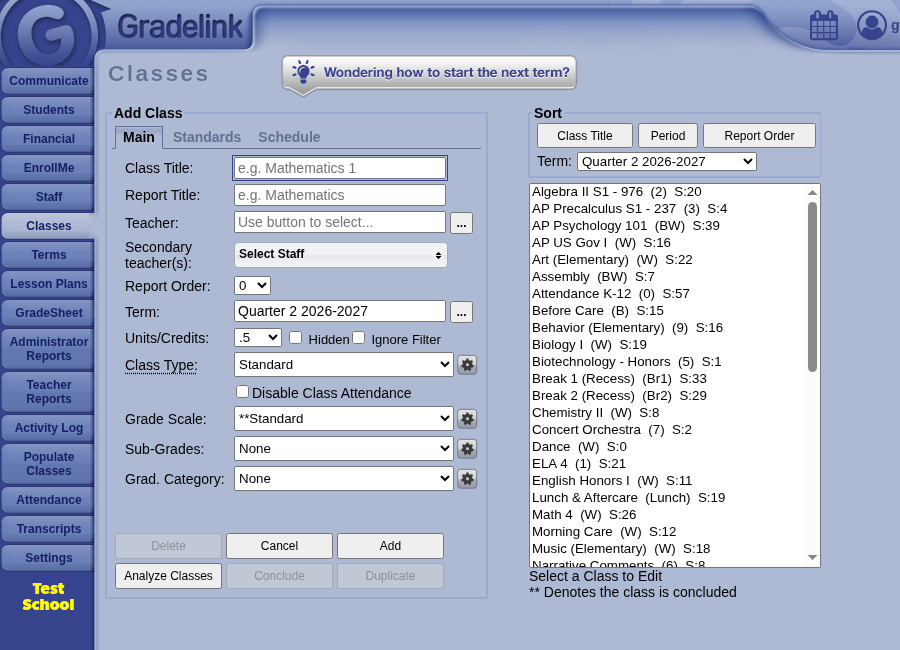 1 2 3 4 5 6
- 1Click the Classes tab on the left sidebar.
- 2Enter a Class Title. This is how the class is referenced inside Gradelink (by teachers and administrators) and on transcripts. Typically include the subject and grade level, and make each Class Title unique, even when several classes teach the same course.
- 3Enter a Report Title. This shows on progress reports and report cards and is what parents and students see in the Student/Parent interface. Leave the grade level off unless you want it next to each subject on the report card.
- 4Select a primary Teacher from the list on the right. To give a team teacher or aide access to the grade sheet, add them under Secondary teacher(s).
- 5Complete the other fields as needed (see the table below).
- 6Click Add to save the class and update the class list.
Important: Everyone with access to a class has equal access: each can edit the grade sheet and attendance. Use caution when making major changes.
| Field | What it does |
|---|---|
| Period | The time of day the class meets. Students won't be placed in two classes with the same period unless overridden. |
| Report Order | Order on report cards and progress reports. Classes with the same value are listed alphabetically. |
| Term | Defaults to the first active term; choose another when preparing an upcoming term. |
| Units/Credits | How much the class is worth toward the GPA (e.g. Math 5, a music elective 0). The default is 5, which can be changed on the Settings tab. |
| Hidden | Keeps the class off report cards, progress reports and the Student/Parent interface; its grades aren't saved to the transcript or permanent record. |
| Ignore Filter | Forces the class onto a student's transcript regardless of other settings (e.g. a middle school class on a high school transcript). |
| Location | Optional room number or location shown on each student's schedule. |
| Class Type | Default is Standard, which builds a grade sheet for assignments. Others include School Attendance and Term Comments; the gear icon creates custom types. |
| Grade Scale | For Standard classes. Default **Standard is A–F. The gear icon opens Manage Grade Scales for alternatives such as O/G/S/N. |
| Sub-Grades | Assessments shown under a subject on the report card. The gear icon manages sub-grade sets. |
| Grad. Category | Counts the class toward a graduation requirement. The gear icon edits the categories. |
Note: Hidden and Ignore Filter aren't visible by default. Contact Gradelink Support to have them enabled.
2. Other class types
Most classes use the default Standard type, which builds a grade sheet for assignments. Gradelink also includes several other built-in types for classes that aren't standard graded courses.
- School Attendance classes are for schools that take attendance daily. Teachers get an attendance entry screen using the attendance values set on the Settings tab. If you take attendance every period instead, skip this and enable Use Class Attendance in Settings, which turns on the Attendance tab for teachers.
- Term Comments classes are for narrative comments printed on the report card. Teachers see a text field for each student along with current grades and attendance.
- Worship Attendance, Sport, Credit / No Credit, Lunch / Extended Care and Preschool are also available for their respective uses.
The gear icon next to Class Type lets you create custom types. For a full breakdown of each built-in type and when to use it, see Built-In Class Types.
3. Edit a class and other tools
- Edit: select a class in the list on the right, change the values on the left, and click Save.
- Delete: classes with grades, attendance or other data can't be deleted by default; administrators have an override on the Settings tab.
- Analyze Classes: if report cards misbehave after the first term, compare terms to find classes that appear only in some terms or whose titles or sub-grades changed.
- Duplicate: copies a class so you don't have to re-enter shared settings.
Prefer video?
This walkthrough is also available as a short video.